The postracial era
I'm Still HereThe postracial era is less a settled historical condition than a story told about the United States: that the election of Barack Obama signaled the overcoming of racism. The book sets that story against evidence that racial power has persisted through changing forms, from slavery and Jim Crow laws to mass incarceration and the militarized policing of Black communities. Its central challenge is not simply to deny progress, but to ask what a claim of progress conceals when Black people still encounter violence, exclusion, and demands to be grateful for inclusion.
The promise and limits of the postracial claim
For millions of white and Black people, Barack Obama’s election appeared to confirm that the United States had become a postracial society. The narrator recalls the force of watching the Obama family wave to crowds in Chicago after the victory speech, an achievement she herself had considered impossible only a year earlier. The significance of that moment is not dismissed. But celebration did not erase fear: given the country’s history of murdering Black civil rights leaders, many Black people worried that someone might assassinate Obama for winning the presidency.
The backlash was visible even amid the language of national progress. The narrator had expected signs, nooses, offensive comics, and protests directed not at Obama’s policies but at his race. She had not mistaken those responses for proof that the country had become postracial; they were evidence that the election had not ended racism. The apparent contradiction is the point: a historic political breakthrough could be real and meaningful while racial hostility remained active around it.
A history that progress narratives leave out
The book rejects accounts of racial injustice as accidental residue from a finished past. Slavery and the system of mass incarceration are described as purposeful inventions, while the national story is said to rely on comforting myths, fragmented timelines, and colonial ideals rather than reckoning with how those systems were made. That reckoning would have to include the Middle Passage, the wealth the South built through enslaved labor and the wealth the North gained from its products, as well as the generations born and buried in slavery without experiencing freedom in the United States.
The Civil War is another point at which the national story evades its racial stakes. The narrator argues that slavery is often displaced by the more palatable explanation of states’ rights, while the determined defense of the power to hold other people in bondage goes unacknowledged. Emancipation did not extinguish the belief in Black inferiority: resentment at slavery’s end helped make the rise of Jim Crow laws possible, and that belief continues in hearts and minds.
The book also refuses to reduce Jim Crow to segregated signs and separate drinking fountains. It meant humiliation and the threat of violence, low wages, taxes paid for services Black people could not fully use, property that could be taken, and little legal recourse. Mob violence, burned homes, bombed churches and businesses, and lynchings made ordinary life a matter of measuring every step. Likewise, accounts of the U.S. Civil Rights Movement can celebrate its victories while sanitizing the spitting, beatings, dogs, bombs, guns, and resistance that preceded them. Treating those struggles as safely concluded obscures the survival of people who defended segregation, redlined Black neighborhoods, and continue to avoid Black communities and schools.
Contemporary evidence against a clean break
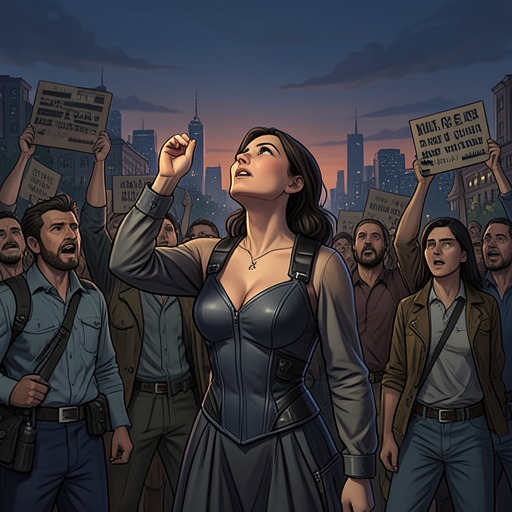
The Ferguson protests and police standoff make the distance between historical violence and the present collapse. Watching television, the narrator saw police in riot gear, with dogs and tear gas, and tanks positioned against Black residents demanding accountability for the shooting of an unarmed teenager. The camera’s wider view made clear that the people facing the police were parents, aunts, uncles, cousins, and children in shorts and T-shirts, not the armed enemy suggested by the spectacle. The images recalled photographs from history books. In the narrator’s account, the equipment had changed—from horses and nightsticks to tanks and automatic rifles—but the treatment of Black residents as enemies of the state felt familiar, not newly invented. That recognition accompanied the rise of the Black Lives Matter movement.
The same resistance to declaring racism finished appears in the book’s accounts of schools and workplaces. In a predominantly white school, the narrator had to decide whether to repeat a textbook’s claim that Christopher Columbus discovered America or point out that the land was already inhabited; she could choose a better grade or affirm Blackness, sometimes losing half a letter grade for telling the truth. Later, at a nonprofit ministry, she sought approval for racial diversity training and heard a board treasurer argue that people from diverse backgrounds should assimilate into one organizational culture. Her body froze as she considered how to challenge a proposal whose promised unity would come at her expense.
A job interview offers another measure of the gap between a public commitment to diversity and the organization’s actual assumptions. When the interviewer’s party discovered that the candidate was a Black woman rather than the white man they expected, their surprise raised an unspoken question about whether she would fit the organization’s white culture. After hiring, assurances that a colleague was a safe person to approach could give way to comments about her hair, requests that she speak more Black, or questions that treated her as an authority on stereotypes about Black life. When she raised these incidents, she might be told she had misunderstood or should show more patience. Naming the system, rather than only the individual offenders, could bring labels such as divisive, negative, and toxic. These experiences show how an institution can praise diversity while leaving its norms and authority largely untouched.
From dialogue to accountability
The book distinguishes racial reconciliation from the appearance of inclusion. Counting Black faces in photographs or meeting a representation quota does not redistribute influence if people of color remain excluded from decisions about a publication’s direction, a ministry’s purpose, or an organization’s vision. In that arrangement, diversity changes the picture without changing who shapes it; people of color are then left to challenge hiring decisions, respond to harmful sermons, and repair the failures of halfhearted initiatives.
Dialogue, too, can imitate change without producing it. A conference, lecture, or sermon about diversity contributes to reconciliation only when it leads to action, shifts power, and pursues justice for those most marginalized. When listening to people of color becomes the endpoint, or when their anger and tone are policed, conversation can serve as a delay rather than a beginning. The book places marches, protests, books, Scripture, art, sermons, and participation in coalitions among the actions that can carry justice work forward. Representation must include influence over leadership, funding, mission, and strategy, rather than gratitude for being invited into a role already defined by others.
The shadow of hope
The narrator does not replace the postracial story with a promise that equality is near. Looking at present-day police violence, racial disparities, backlash against political correctness, hostility toward the first Black president, and the gutting of the Voting Rights Act, she does not believe that she, her children, or her grandchildren will live in a United States that has achieved racial equality. That forecast makes the language of progress inadequate, but it does not make action meaningless.
Hope is described instead as a shadow: continuing to show up without knowing whether the desired future will arrive within one’s lifetime. The narrator locates that persistence in the resistance, teaching, voices, and faith of Black people who came before her. Speaking, writing, loving, and returning to work after disappointment become ways of laboring toward a world that remains unseen. The postracial era, in this account, is a claim that can obscure unfinished history; the alternative is neither easy optimism nor surrender, but the duty to continue acting without certainty of the outcome.